Salesforce Sales Cloud — Complete AI Tool Review
Salesforce Sales Cloud is not simply a CRM — it is the definitive operating system for enterprise revenue generation. Trusted by over 150,000 businesses worldwide, including more than 80% of Fortune 500 companies, Salesforce has defined what enterprise CRM means for over two decades. With the continuous evolution of Einstein AI and the 2024 introduction of Agentforce — Salesforce’s autonomous AI agent platform — the system has moved far beyond data storage into active, AI-driven business intelligence and process automation.
What makes Salesforce uniquely powerful in 2025 is not just the breadth of its AI features but the historical depth of data those AI features draw from. Einstein AI has been trained on trillions of CRM data points accumulated across 25 years and 150,000+ customer deployments. When Einstein predicts deal outcomes, it is not making generic statistical guesses — it is drawing on the largest longitudinal B2B sales dataset in existence. This data advantage compounds every AI prediction the system makes.
Einstein AI — The Complete Capability Breakdown
- Einstein Copilot: A conversational AI assistant embedded in every Salesforce product that has full context of your CRM data. Ask it in natural language: ‘Summarize everything I know about Acme Corp before my 2pm call’, ‘Draft a personalized renewal email for the Johnson & Sons account’, ‘Which deals in my pipeline are most at risk this quarter and why?’ Unlike generic AI assistants that start from zero context, Einstein Copilot draws on your live CRM data — contacts, deals, communications history, and pipeline intelligence — to provide specific, accurate, actionable responses. It does not guess; it reasons from your actual business data.
- Agentforce — Autonomous AI Agents: Salesforce’s most significant 2024 innovation, Agentforce goes beyond assisted AI to autonomous AI. Agentforce agents can independently execute multi-step business processes without human prompting: qualifying inbound leads and routing them to the correct rep, handling routine customer service inquiries from first contact to resolution, managing standard sales operations tasks like opportunity updates and activity logging, and processing reorder requests in distribution businesses. Agentforce agents are built using a no-code builder in Salesforce Studio and can be deployed across sales, service, marketing, and operations functions. Each agent has a defined scope and escalation path to human handlers for out-of-scope situations.
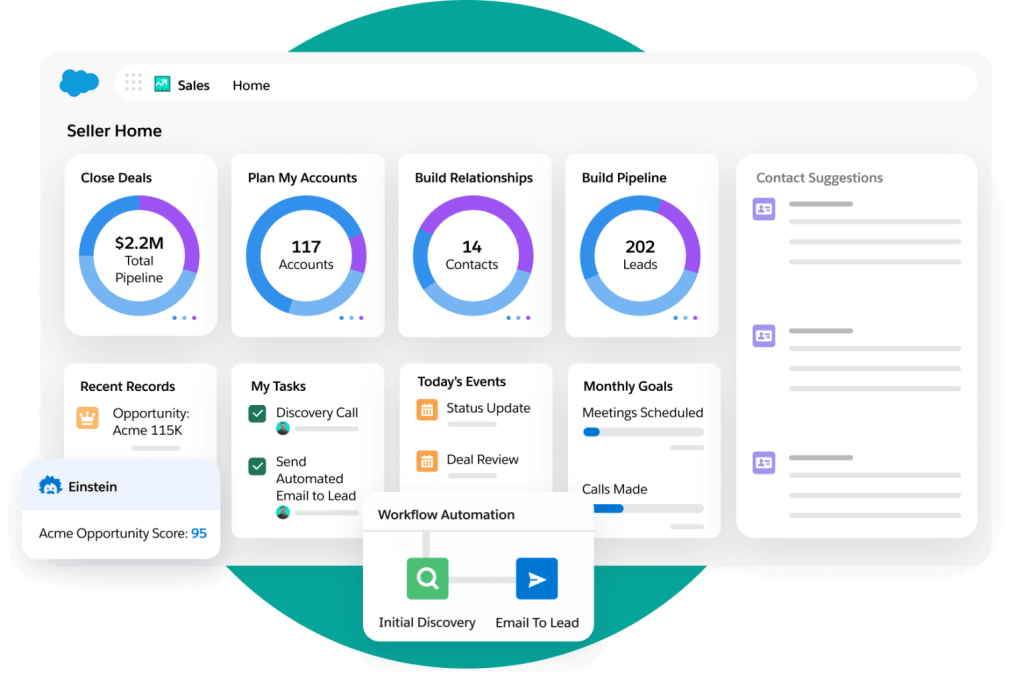
- Einstein Lead Scoring: A machine learning model trained on your own historical won and lost deals that assigns every inbound lead a 0–100 score reflecting their probability of converting. The model analyzes 200+ signals — demographic data, company attributes, behavioral engagement signals, and historical interaction patterns — specific to your business. Lead scores update dynamically as new information arrives. Sales reps prioritize their daily calling based on AI-ranked lead lists rather than recency or gut feeling, consistently improving conversion rates within 90 days of implementation.
- Einstein Opportunity Scoring and Insights: Active pipeline monitoring that goes beyond static stage tracking. Einstein continuously analyzes deal health across dozens of signals — communication frequency and recency, sentiment trends in emails and calls, comparison to historical deals that followed similar patterns, and rep behavior relative to successful past deals. When a deal shows risk signals, Einstein flags it proactively in the rep’s dashboard with a specific explanation: ‘No activity with this account in 18 days — deals with this pattern historically close at 23% lower rate.’ The system recommends specific recovery actions tailored to the deal’s current situation.
- Einstein Activity Capture and Automatic Data Entry: One of the biggest reasons CRM implementations fail is data entry — reps resist manually logging every email, call, and meeting. Einstein Activity Capture solves this by automatically syncing all Gmail/Outlook emails and calendar events to the corresponding Salesforce records. AI extracts key information from email threads — company names, deal amounts, product mentions, next steps, and contact details — and populates CRM fields automatically. Data stays current without any rep manual input, preserving CRM integrity and giving managers accurate pipeline views.
- Revenue Intelligence: A premium AI analytics layer that combines Salesforce pipeline data with Tableau visualization to produce real-time revenue intelligence. Revenue Intelligence provides AI-adjusted forecast submissions that are demonstrably more accurate than manager-rolled-up CRM forecasts, pipeline health trend analysis across the entire book of business, rep-level performance coaching recommendations based on activity patterns, and territory-level variance analysis that identifies where revenue shortfalls are developing before they become crises. Organizations using Revenue Intelligence report 20–30% improvement in forecast accuracy within 6 months.
- Einstein Conversation Insights: AI analysis of sales call recordings and transcripts across Zoom, Teams, Webex, and phone. Automatically identifies competitor mentions across all calls (market intelligence at scale), extracts recurring customer objections and product feature requests, generates call summaries and action items, and correlates specific rep behaviors — talk ratio, question frequency, objection handling techniques — with deal outcomes. Sales managers use these insights to move from opinion-based coaching (‘I think you should ask more questions’) to evidence-based coaching (‘Reps who ask 4+ discovery questions in the first call close 31% more deals in this segment’).
Salesforce Pricing — Every Plan Explained
Starter Suite ($25/user/month): Basic CRM including accounts, contacts, leads, opportunities, and limited AI features. Email integration, standard reports, and mobile access included. Best for small teams or departments starting with Salesforce for the first time.
Pro Suite ($100/user/month): Full sales automation, custom pipeline stages, advanced forecasting, customizable dashboards, Einstein lead scoring, and opportunity insights. Suitable for active sales teams needing real AI-powered prioritization.
Enterprise ($165/user/month): Full platform customization including custom objects and fields, territory management, workflow automation builder, Einstein Copilot access, advanced security controls, and Slack integration. The most commonly deployed tier for mid-market and enterprise organizations.
Unlimited ($330/user/month): Everything in Enterprise plus 24/7 dedicated premier support, unlimited storage, additional API capacity, and full Agentforce platform access for building autonomous agents.
Unlimited+ ($500/user/month): Includes Einstein AI credits for all generative AI features, complete Agentforce access, Data Cloud integration for unified customer data from all sources, and dedicated customer success resources.
Implementation Realities — What to Expect
Salesforce has a deserved reputation for implementation complexity. A basic Salesforce deployment — standard objects, email integration, reporting — takes 4–8 weeks with a dedicated administrator or implementation partner. A full enterprise deployment including custom objects, territory management, CPQ (configure-price-quote), and integrations with ERP and marketing automation typically takes 3–6 months. Enterprise implementations with deep customization, change management, and user training programs can run 6–18 months.
Implementation cost is a critical planning factor. Salesforce consultants typically charge $150–$300 per hour. A mid-complexity implementation project typically requires 100–300 hours of consulting work, meaning implementation costs of $15,000–$90,000 on top of software licensing. Budget both line items before making the Salesforce decision — many organizations discover that annual implementation and consulting costs exceed software licensing costs in the first 1–2 years.
Who Should Use Salesforce Sales Cloud
- Enterprise organizations with complex sales structures: Companies with 100+ person sales teams, multiple product lines, channel partners, geographic territories, and sophisticated revenue operations requirements. Salesforce’s depth of customization, governance, and analytics is genuinely necessary — not just preferable — at this scale.
- Regulated industry businesses: Financial services, healthcare, pharmaceutical, and government contractors where data governance, audit trails, field-level security, regulatory compliance reporting, and certified security infrastructure are non-negotiable requirements. Salesforce holds FedRAMP, HIPAA, GDPR, ISO 27001, SOC 2 Type II, and PCI DSS certifications.
- Companies with dedicated RevOps teams: Organizations with revenue operations, sales operations, or CRM administration specialists who can configure, maintain, and continuously optimize the platform. Salesforce delivers maximum ROI when managed by dedicated professionals who understand both the business requirements and the platform capabilities.
Salesforce vs HubSpot — The Honest Decision Framework
For businesses under approximately 150 employees without a dedicated CRM administrator, HubSpot delivers faster time-to-value at significantly lower total cost of ownership. HubSpot’s AI capabilities (Breeze AI) are now genuinely competitive for SMB and mid-market use cases. For businesses above 150 employees with complex territory structures, custom object requirements, enterprise compliance needs, or deep ERP integration requirements — Salesforce’s architecture is genuinely the right tool, not just a more expensive one. The decision is about organizational complexity matching, not prestige.