

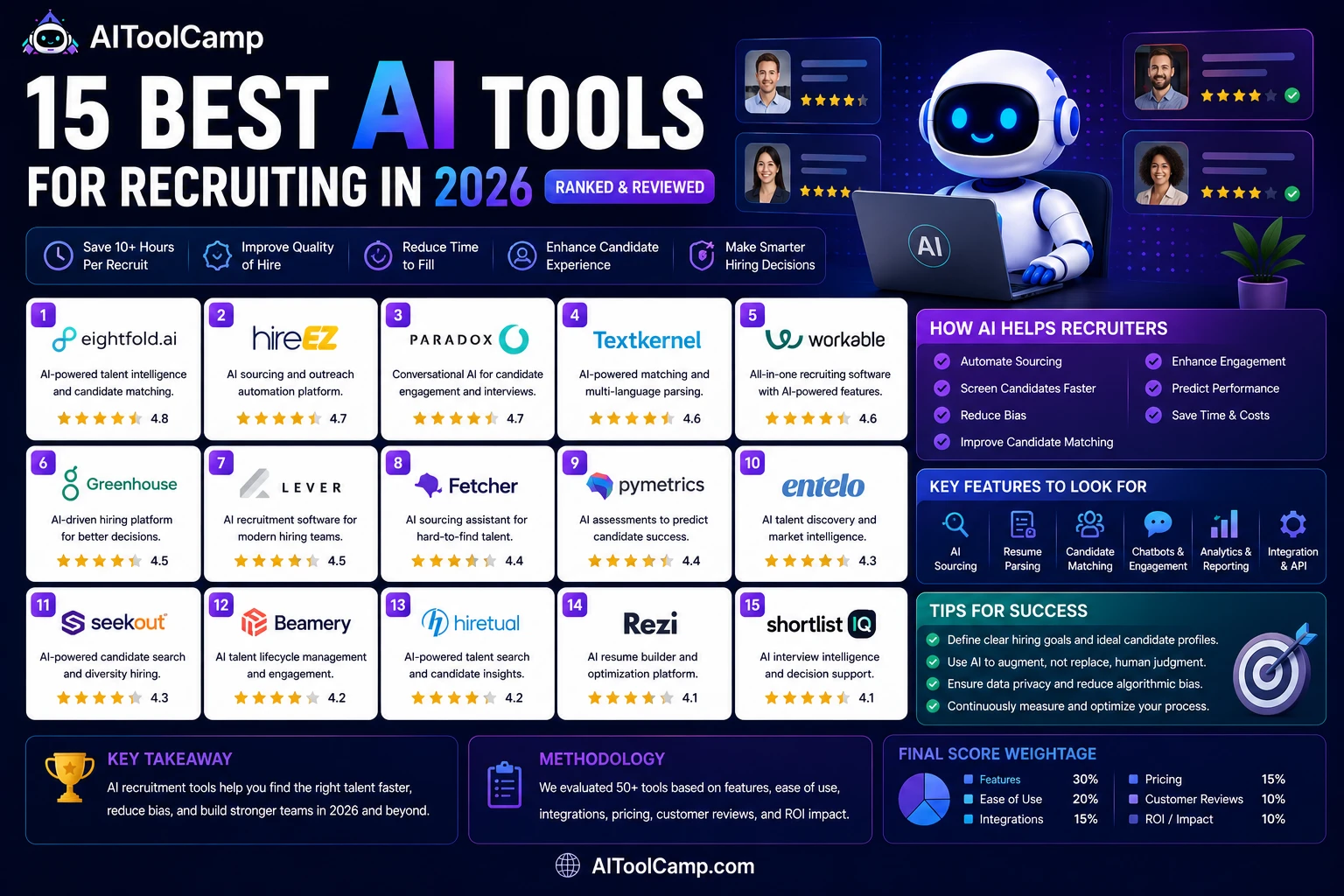
15 Best AI Tools for Recruiting in 2026 (Tested & Compared)
Hiring in 2026 doesn’t look like it did even two years ago. Recruiters aren’t just posting jobs and waiting for resumes to trickle in anymore — many are now working alongside autonomous AI agents that source candidates, run conversational screening interviews, rank applicants, and handle scheduling in the background, 24 hours a day.
If you’re trying to cut time-to-hire, lower cost-per-hire, or simply stop drowning in applications, the right AI recruiting stack matters more than it ever has. In this guide, we break down the 15 best AI recruiting tools for 2026 — covering sourcing, screening, interviewing, scheduling, assessments, background checks, and full ATS replacements — so you can find the one (or two) that actually fix your biggest hiring bottleneck.
If you’re building out your broader AI stack, our guide to the best AI copywriting tools covers the content side of recruitment marketing and employer branding, and you can browse our full AI tools directory for comparisons across every business function.
Quick Picks: Best AI Recruiting Tools by Use Case
If you’re short on time, here’s the fastest way to find your match:
| Use Case | Top Pick | Why It Wins |
|---|---|---|
| Passive candidate sourcing | Juicebox | Natural-language search across 800M+ profiles, plus autonomous sourcing agents |
| High-volume frontline hiring | Kiku | AI agent screens candidates 24/7 by voice or chat in 100+ languages |
| Conversational scheduling | Paradox | “Olivia” handles candidate FAQs and scheduling at scale |
| Built-in ATS + AI screening | Pinpoint | AI Candidate Filters score applicants against your exact criteria |
| Enterprise structured interviews | HireVue | Science-backed, audit-ready video assessment models |
| Skills-based assessments | Canditech | 500+ job simulations with AI scoring and anti-cheating detection |
| Resume + video + assessment in one | Truffle | Combines all three signals with transparent match scoring |
| Talent intelligence & internal mobility | Eightfold AI | Skills-based matching across hiring and internal moves |
| Background screening | Checkr | AI-assisted verification and fraud detection in hours, not days |
| Budget-friendly all-in-one ATS | Workable | AI ranking and sourcing automation built for SMBs |
Why AI Recruiting Tools Matter in 2026
The biggest shift this year is the move from “AI-assisted” to “AI-autonomous.” According to Korn Ferry’s 2026 Talent Acquisition Trends research, more than half of talent leaders plan to add autonomous AI agents to their teams in 2026 — agents that don’t just suggest candidates but actively source, screen, and shortlist them without a recruiter clicking a button.
That shift is being driven by volume. Application numbers have exploded as candidates use AI to apply to more roles, faster, which means recruiting teams need AI on their side of the funnel just to keep up. At the same time, regulators are paying closer attention: hiring-related AI is increasingly classified as “high-risk” under frameworks like the EU AI Act, which means explainability and audit trails aren’t optional extras anymore — they’re a buying criterion. For a deeper look at the numbers behind this shift, SQ Magazine’s AI recruitment statistics roundup is a useful reference.
In practice, AI recruiting software now typically helps with:
- Candidate sourcing — finding passive and active candidates using natural language instead of Boolean strings
- Resume and application screening — automatically ranking and shortlisting applicants against your job criteria
- Conversational screening — AI-led chat or voice interviews that run at any hour, in multiple languages
- Interview scheduling — removing the back-and-forth of calendar coordination
- Candidate communication — personalized outreach, status updates, and FAQ handling
- Background and compliance checks — faster, AI-assisted verification with built-in audit trails
How We Evaluated These Tools
We looked at each platform across five criteria: sourcing and screening accuracy, depth of ATS and HRIS integrations, how much of the workflow can run autonomously versus requiring a human in the loop, pricing transparency, and — increasingly important — how well the tool explains its own scoring and decisions. That last point matters more every year, since “the AI rejected this candidate and we don’t know why” is no longer an acceptable answer for hiring teams that need to defend their decisions to candidates, hiring managers, or regulators.
The 15 Best AI Recruiting Tools in 2026
1. Juicebox — Best for AI-Powered Candidate Sourcing
Juicebox (formerly known as PeopleGPT) replaced Boolean search strings with plain-English prompts. Type something like “senior frontend engineer in Berlin who’s worked at a startup and speaks German,” and Juicebox returns a ranked list pulled from over 800 million profiles across 30+ data sources.
Key features:
- Natural-language search (PeopleGPT) across 800M+ candidate profiles
- Juicebox Agents — autonomous sourcing agents that run 24/7 and learn from recruiter feedback
- Fit scores and skill highlights for every result, with reasoning attached
Best for: Talent teams that need to find and prioritize passive candidates quickly, without writing complex search strings.
Pricing: Plans typically run $139–$199 per seat/month.
2. Paradox — Best for Conversational AI and Scheduling
Paradox’s conversational AI assistant, Olivia, handles candidate communication, FAQs, and interview scheduling automatically. It’s especially popular with high-volume hiring teams in retail, logistics, and hospitality, where applicant volume makes manual scheduling impractical.
Key features:
- Conversational AI assistant (Olivia) for candidate chat, SMS, and scheduling
- Automated interview booking that removes calendar back-and-forth
- Built for high-volume, frontline-heavy hiring environments
Best for: High-volume hiring teams that need 24/7 candidate communication without adding headcount.
3. Humanly — Best for AI Recruiter and Talent CRM
Humanly gives candidates an AI Recruiter that reaches every applicant within seconds via SMS, chat, or email, then runs structured AI Interviewer sessions by voice or video. An AI Notetaker captures and summarizes live interviews automatically. The platform leans heavily into auditability — every interaction is logged, transcribed, and permissioned — so hiring decisions stay explainable and compliant.
Key features:
- AI Recruiter for 24/7 candidate engagement across channels
- AI Interviewer that conducts and ranks structured screening interviews
- AI Notetaker for automatic interview summaries
- Full audit logs, transcripts, and permission controls
Best for: Teams that want a largely automated screening workflow without sacrificing governance and audit trails.
4. Pinpoint — Best for Automated Candidate Screening
Pinpoint is a full applicant tracking system built around five stages — Plan, Attract, Engage, Select, and Onboard — with AI woven through each one. Its AI Candidate Filters let you describe exactly what you’re looking for (skills, experience level, specific job description criteria) and the system scores and flags applicants automatically. A Blind Recruitment feature anonymizes applications during early screening to reduce bias.
Key features:
- AI Candidate Filters that score and flag applicants against custom criteria
- Blind Recruitment for anonymized, bias-reducing screening
- Native integrations with LinkedIn, Indeed, Glassdoor, Slack, DocuSign, Google Calendar, Outlook, and Checkr
Best for: Companies that want a single ATS with built-in AI screening rather than a bolt-on tool.
5. Greenhouse — Best for AI-Powered Content Generation
Greenhouse remains one of the most widely adopted ATS platforms for structured hiring, and its AI layer focuses on writing — job descriptions, candidate outreach messages, and interview kits — while keeping the structured scorecards and interview plans Greenhouse is known for.
Key features:
- AI-generated job descriptions, outreach templates, and interview kits
- Deep structured-hiring framework (scorecards, interview plans, hiring team workflows)
- Broad integration ecosystem across HRIS, assessments, and background check providers
Best for: Mid-size to enterprise teams that already rely on Greenhouse for structured hiring processes and want AI to speed up the writing-heavy parts.
6. Kiku — Best for Autonomous High-Volume Screening
Kiku is built specifically for frontline, high-volume hiring — think retail, logistics, hospitality, and healthcare. Its AI agent, Sara, screens candidates by voice or chat in more than 100 languages, around the clock, and integrates with 100+ ATS platforms (including Greenhouse, Lever, Workable, and Teamtailor) in about a week. Companies using Kiku report the large majority of candidates screened within 24 hours of applying, with strong candidate satisfaction scores.
Key features:
- Fully autonomous AI screening agent (Sara) by voice or chat
- 100+ language support for global frontline hiring
- ATS-agnostic integration, typically live within a week
- Automatically resurfaces strong-fit candidates from your existing talent pool
Best for: High-volume frontline hiring teams with minimal recruiter bandwidth who need applicants screened the same day they apply.
7. Truffle — Best for Resume Review and Video Screening
Truffle combines resume screening, asynchronous one-way video interviews, and talent assessments (personality, situational judgment, and environment fit) into a single workflow. AI generates transcripts, summaries, and match scores with visible reasoning — plus “Candidate Shorts,” short highlight clips that surface the most relevant moments from each video. Unlike tools that make rejection decisions for you, Truffle is positioned as a signal layer: it ranks and explains, but a human still makes the call.
Key features:
- Resume parsing and ranking against your stated requirements
- Async one-way video interviews with AI summaries and match scores
- Personality, situational judgment, and environment-fit assessments
- AI Check flags responses that show signs of AI assistance
Best for: Lean in-house recruiting teams that are getting buried in applications and need a faster, more defensible shortlist without outsourcing the final decision.
Pricing: Plans start around $99/month (billed annually), with flat pricing rather than per-seat charges.
8. HireVue — Best for Enterprise Structured Interviews
HireVue is built for enterprise teams that need structured, science-backed video interview assessments at scale, backed by compliance and validation documentation — a major factor for large organizations operating across multiple jurisdictions.
Key features:
- Structured, validated video interview assessments
- Enterprise-grade compliance and scoring-model documentation
- Scheduling and candidate communication automation built for high-volume enterprise pipelines
Best for: Large enterprises that need defensible, structured interview data they can stand behind in an audit.
9. Eightfold AI — Best for Talent Intelligence
Eightfold AI uses deep-learning talent intelligence to match candidates to roles based on skills and potential rather than keyword overlap. It’s frequently paired with autonomous sourcing tools for end-to-end coverage, but its real strength is connecting external hiring with internal mobility — surfacing existing employees who could move into open roles before you even post the job externally.
Key features:
- Skills- and potential-based candidate-to-role matching
- Internal mobility recommendations alongside external sourcing
- Enterprise-scale talent intelligence across hiring, development, and workforce planning
Best for: Enterprises that want skills-based internal mobility and external sourcing working from the same data.
10. Workable — Best for Prioritizing Qualified Candidates
Workable ranks applicants by qualification fit and automates repetitive sourcing tasks, making it a solid all-in-one option for small and mid-sized businesses that don’t have a dedicated TA team.
Key features:
- AI-driven applicant ranking by qualification fit
- Automated sourcing across job boards
- Workable Agent for AI-assisted recruiting workflows (currently strongest for US-based customers)
Best for: SMBs that want an affordable, easy-to-use AI-enabled ATS without enterprise complexity.
11. Canditech — Best for AI-Powered Candidate Assessments
Canditech focuses on skills-based assessments — a library of 500+ job simulation tests, plus the ability to generate a custom test directly from a job description. AI auto-scores results and combines them with one-way video interviews, while built-in cheating-prevention tools (including AI-generation detection and tab-tracking) help keep results trustworthy in an era of AI-assisted applications.
Key features:
- 500+ pre-built job simulation tests, or generate one from your job description
- AI auto-scoring for technical and soft-skill assessments
- One-way video interviews layered onto assessment results
- Cheating-prevention tools, including AI-response detection
Best for: Technical and skills-heavy roles where objective, comparable assessment data matters more than resume keywords.
12. Checkr — Best for AI-Powered Background Screening
Checkr uses AI to compress background checks from days into hours and flag compliance issues automatically. Beyond standard verification, its AI can explain complex legal charges in plain language, cross-check past job titles against employer data, and analyze uploaded documents like diplomas or pay stubs for signs of alteration — directly addressing the rise in AI-assisted resume fraud. It integrates with most major ATS and HRIS platforms, including Greenhouse, Workday, BambooHR, Rippling, and ClearCompany.
Key features:
- AI-accelerated background checks, often completed in hours
- Plain-language explanations of legal record complexities
- Document analysis to detect altered diplomas, pay stubs, and similar fraud
- Integrations with 100+ HR and recruiting platforms
Best for: Teams that need fast, compliant background screening at scale, integrated directly into their existing ATS.
13. Recruit CRM — Best for AI Email Sequencing
Recruit CRM is built for staffing and recruitment agencies juggling multiple client pipelines at once. Its AI-powered email sequencing automates candidate and client outreach based on engagement signals, helping agency recruiters stay on top of dozens of active searches without manually tracking every follow-up.
Key features:
- AI-driven email sequencing based on candidate/client engagement
- Combined ATS and CRM built for agency workflows
- Pipeline management across multiple simultaneous client searches
Best for: Recruitment agencies managing multiple client pipelines that need outreach to run on autopilot.
14. ClearCompany — Best for AI-Driven Talent Acquisition
ClearCompany takes an end-to-end approach, with AI-driven recruiting sitting inside a broader talent management platform that extends into performance reviews, goal tracking, and 360-degree feedback. For hiring teams specifically, the standout is interview scheduling automation — the system coordinates and confirms across all parties, generates video interview links, compiles interview packets, and sends reminders without recruiter involvement.
Key features:
- Multi-board job posting and a flexible ATS
- Automated interview scheduling, including auto-generated video links and interview packets
- Text recruiting templates for fast candidate communication
- Built-in performance reviews and goal tracking beyond hiring
Best for: In-house talent acquisition teams that want recruiting and broader talent management — onboarding, performance, development — in one connected platform.
15. Findem — Best for Autonomous Sourcing Agents
Findem takes a contextual approach to sourcing rather than a keyword-based one. Instead of matching titles, it understands attributes like “rapid career progression” or “transitioned from consulting to tech,” searching across 750 million profiles and 100,000+ data sources. Its library of more than 2 million expert-labeled “Success Signals” and “Relationship Signals” identifies warm-network paths to candidates, which Findem reports can produce significantly higher response rates than cold outreach. Its “Fia” assistant converts plain-language requests into searches and outreach with explainable rankings, and autonomous Findem Agents can run sourcing continuously.
Key features:
- Contextual, attribute-based candidate search (not just keyword matching)
- 750M+ profiles across 100,000+ data sources
- “Success Signals” and “Relationship Signals” for warm-network outreach
- Autonomous Findem Agents with explainable, recruiter-controlled rankings
Best for: Enterprise teams ready to hand a meaningful share of sourcing to autonomous agents while keeping explainability intact.
AI Recruiting Tools Comparison Table
| Tool | Best For | Standout AI Feature | Starting Price |
|---|---|---|---|
| Juicebox | Candidate sourcing | Natural-language search + autonomous sourcing agents | ~$139–$199/seat/mo |
| Paradox | Conversational scheduling | “Olivia” AI assistant for chat and scheduling | Custom |
| Humanly | AI recruiter + CRM | 24/7 AI Recruiter with audit trails | Custom |
| Pinpoint | Automated screening | AI Candidate Filters + Blind Recruitment | Custom |
| Greenhouse | Content generation | AI job descriptions, outreach, interview kits | Custom |
| Kiku | High-volume screening | 24/7 multilingual AI screening agent (Sara) | Custom |
| Truffle | Resume + video screening | Resume, video, and assessment match scoring | ~$99/mo flat |
| HireVue | Enterprise interviews | Validated structured video assessments | Custom |
| Eightfold AI | Talent intelligence | Skills-based matching + internal mobility | Custom |
| Workable | SMB ATS | AI applicant ranking + sourcing automation | Custom |
| Canditech | Candidate assessments | 500+ AI-scored job simulations | Custom |
| Checkr | Background screening | AI fraud detection + document analysis | Custom |
| Recruit CRM | Agency email sequencing | AI engagement-based outreach sequences | Custom |
| ClearCompany | Talent acquisition suite | AI-automated interview scheduling | Custom |
| Findem | Autonomous sourcing | Contextual matching + warm-network signals | Custom |
Most enterprise platforms price by seat count, applicant volume, or company size and require a quote — request a demo for an exact number before committing.
How to Choose the Right AI Recruiting Tool
Before picking a tool, identify your single biggest bottleneck — most teams have one obvious pain point, even if everything feels broken at once:
- Sourcing bottleneck (not enough qualified candidates in the pipeline) → Juicebox, Findem, Eightfold AI
- Screening bottleneck (too many applicants, not enough hours) → Truffle, Canditech, Humanly, Kiku
- Scheduling and communication bottleneck (interviews fall through the cracks) → Paradox, Kiku, ClearCompany
- ATS replacement with built-in AI (you’re still running everything through spreadsheets and email) → Pinpoint, Greenhouse, Workable
- Compliance and verification bottleneck (background checks slow everything down) → Checkr
If you’re an agency rather than an in-house team, Recruit CRM’s pipeline-and-sequencing approach is worth evaluating first, since agency workflows differ enough from in-house hiring that general ATS platforms often feel like a poor fit.
One practical tip: whatever you choose, confirm it integrates with the ATS or HRIS you already run. A disconnected point solution that requires copying data between systems will eat back most of the time savings the AI was supposed to create.
AI Recruiting, Bias, and Compliance: What to Know Before You Buy
AI in hiring is under more regulatory scrutiny than ever, and that’s not going away. The EU AI Act classifies recruitment AI as high-risk, with significant penalties for non-compliance and enforcement deadlines already in effect — which means any tool used to screen, score, or rank candidates needs to be able to explain why it made a given decision, not just what the decision was. In the US, the regulatory picture has shifted as well, with federal guidance on AI in hiring evolving rapidly. For a closer look at the current rules and how they’re affecting hiring teams, SQ Magazine’s compliance breakdown is a good starting point.
Practically, this means three things when you’re evaluating any tool on this list:
- Ask for explainability, not just accuracy. A tool that can show why a candidate was ranked the way it was is far easier to defend than one that returns a black-box score.
- Check for audit logs. If a candidate challenges a decision, you need a record of what the AI saw, what it recommended, and who acted on it.
- Keep a human in the final decision. Most platforms on this list — including Truffle, Pinpoint, and Humanly — are explicitly designed to surface signal and ranking while leaving the hire/no-hire call to a person, which is both good practice and increasingly a legal requirement.
Frequently Asked Questions
What is the best AI recruiting tool overall?
There isn’t a single “best” tool because AI recruiting platforms specialize. Juicebox leads for sourcing passive candidates, Pinpoint and Greenhouse lead for ATS-built-in screening, and Kiku or Paradox lead for high-volume conversational hiring. Start from your biggest bottleneck rather than a generic “best overall” list.
Can AI recruiting tools replace recruiters entirely?
No — and most platforms aren’t designed to. Tools like Truffle, Humanly, and Findem are explicitly built to surface ranked, explainable signal so a human recruiter or hiring manager makes the final call. The tools remove repetitive admin work (sourcing, screening, scheduling) so recruiters can focus on relationship-building and final decisions.
Do AI recruiting tools reduce hiring bias?
They can, but only when implemented carefully. Features like Pinpoint’s Blind Recruitment anonymize applications during early screening, and assessment platforms like Canditech focus on standardized, comparable scoring rather than subjective resume impressions. However, AI models can also inherit bias from training data, which is why explainability and audit trails (covered above) matter so much.
How much do AI recruiting tools cost?
It varies widely by category. Sourcing tools like Juicebox run roughly $139–$199 per seat per month. Screening tools like Truffle start around $99/month flat. Most enterprise ATS and talent intelligence platforms (Greenhouse, HireVue, Eightfold AI, ClearCompany) use custom, quote-based pricing tied to company size and applicant volume.
What is an “autonomous AI recruiting agent”?
An autonomous AI recruiting agent is software that can independently complete multi-step recruiting tasks — sourcing candidates, sending outreach, screening responses, and building a shortlist — without a recruiter manually triggering each step. Kiku, Findem, and Juicebox’s agent features are examples of this category, which is the fastest-growing segment of AI recruiting heading into 2026.
Are AI screening interviews legal?
In most jurisdictions, yes, but with conditions. AI-driven assessments increasingly fall under “high-risk” classifications in frameworks like the EU AI Act, which require transparency about how AI is used in hiring decisions and often require candidates be informed when AI is involved. Always check local requirements before deploying AI-led interviews, and choose platforms — like HireVue and Humanly — that publish validation and compliance documentation.
Final Thoughts
The best AI recruiting tools in 2026 don’t replace recruiters — they remove the admin work and sharpen decision-making so hiring teams can spend their time on people, not paperwork. Start by mapping your hiring workflow’s single biggest pain point, then pilot one or two tools from this list before rolling them out across your organization.
For more software comparisons and AI tool reviews across HR, marketing, and finance, browse the full AIToolCamp tools library or check out our related guide to the best AI tools for accounting teams.