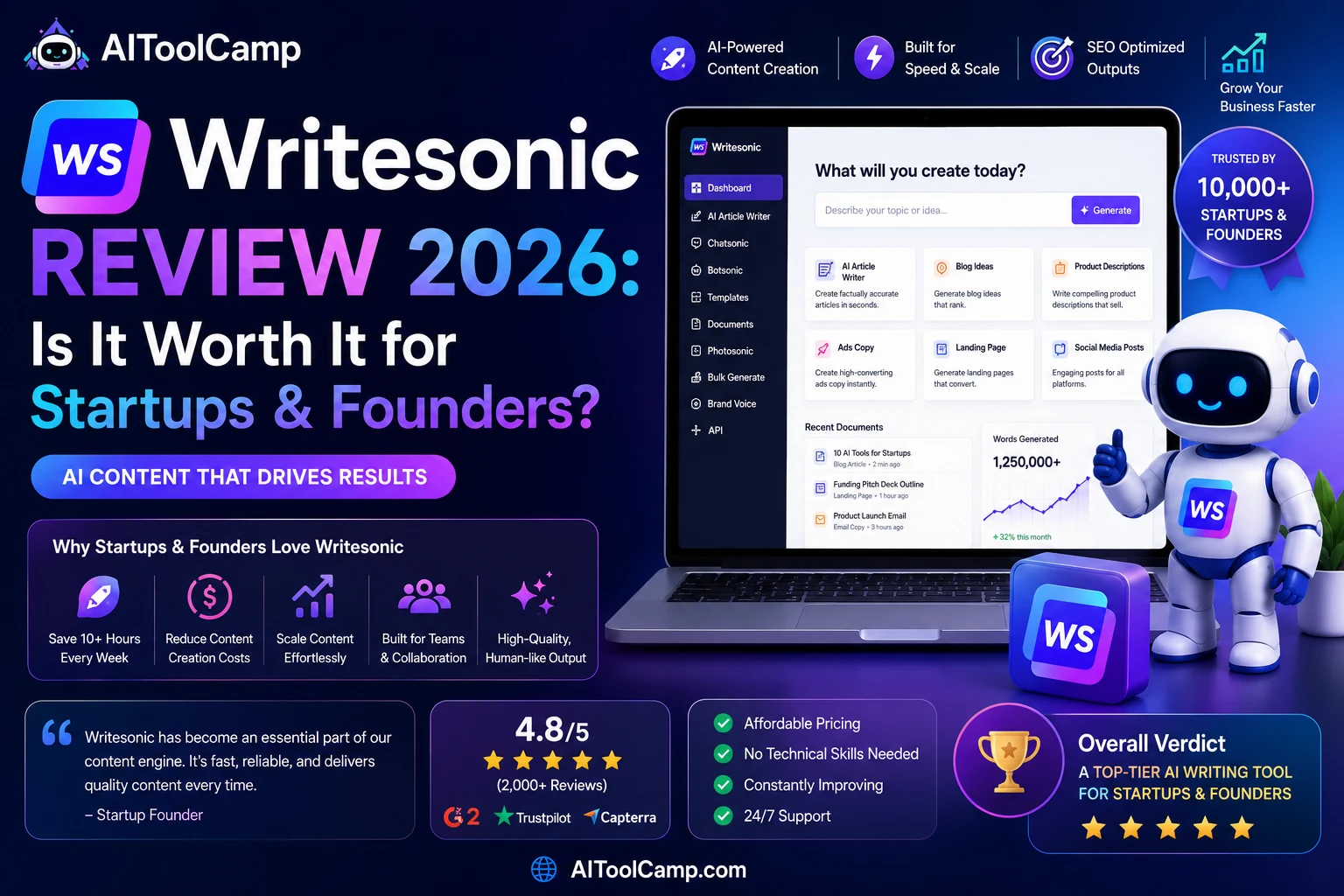
If you’ve been comparing AI writing tools for your startup, chances are Writesonic has landed on your shortlist. It shows up everywhere — review roundups, YouTube breakdowns, Reddit threads — positioned as the budget-friendly alternative to Jasper with a growing SEO feature stack.
But is it actually the right tool for a founder trying to build content momentum without burning runway?
We put Writesonic through a critical lens so you can make a clear-eyed decision. This review covers everything: what it does, what it gets wrong, who it’s actually built for, and whether the pricing holds up against the value it delivers in 2026.
Quick verdict: Writesonic is a capable content drafting engine with a genuinely differentiated GEO (AI search visibility) feature — but inconsistent output quality, a confusing pricing history, and a steep jump to unlock the best features make it a conditional recommendation for startups.
Writesonic is an AI content platform founded in 2020 in San Francisco. It started life as a straightforward AI copywriting tool — good for short-form ad copy, email subject lines, and landing page blurbs. By 2026, it has repositioned itself as a full SEO and AI Search Visibility platform, targeting marketing teams and content operations at growing companies.
The core product is built around three pillars:
There are also companion tools — Botsonic (no-code chatbot builder), Audiosonic (AI voiceover), and Socialsonic (LinkedIn content) — but these are largely sold as separate products or locked behind higher tiers.
Used by: Over 20,000 teams globally across marketing, content, and agency workflows.
G2 Rating: ~4.7/5 | Capterra: 4.5/5
The flagship feature. You input a target keyword, and Writesonic researches competitor content, generates a structured outline with H2s and H3s, and produces a full article — typically in under 60 seconds for a 1,500-word piece.
What makes Article Writer 6.0 different from the earlier versions is the research depth. It pulls from 100+ sources during the generation phase and attempts to weave in real citations, internal linking suggestions, and keyword placement. For a startup publishing weekly blog content to build organic traffic, this is a meaningful time-saver.
The output, however, requires honest editorial review. Multiple users across G2 and Trustpilot note that long-form drafts can read as generic without heavy human editing. Think of it as a capable first-draft engine — not a ghostwriter. You will still need a human to add POV, product-specific insights, and anything that requires genuine expertise.
If you want to compare how this stacks up against other content tools, check our Loom AI Review and Otter.ai Review to see how AI-assisted tools perform across different content formats.
Chatsonic is Writesonic’s answer to ChatGPT, built specifically for marketing workflows. In 2026, it lets you switch between GPT-4o, Claude 3.7 Sonnet, and Gemini 1.5 Pro inside the same conversation window — without jumping between separate subscriptions. It also includes real-time web search, file uploads (PDFs, images, audio), image generation via Flux 1.1, and a built-in Brand Voice feature that keeps outputs consistent with your company’s tone.
For research-heavy content workflows — competitor analysis, trend pieces, product comparisons — Chatsonic is genuinely useful. It behaves less like a general chatbot and more like a dedicated marketing research assistant.
The catch: Source citation consistency is not always reliable. For teams that need verifiable data for investor-facing content or technical documentation, this is a real limitation.
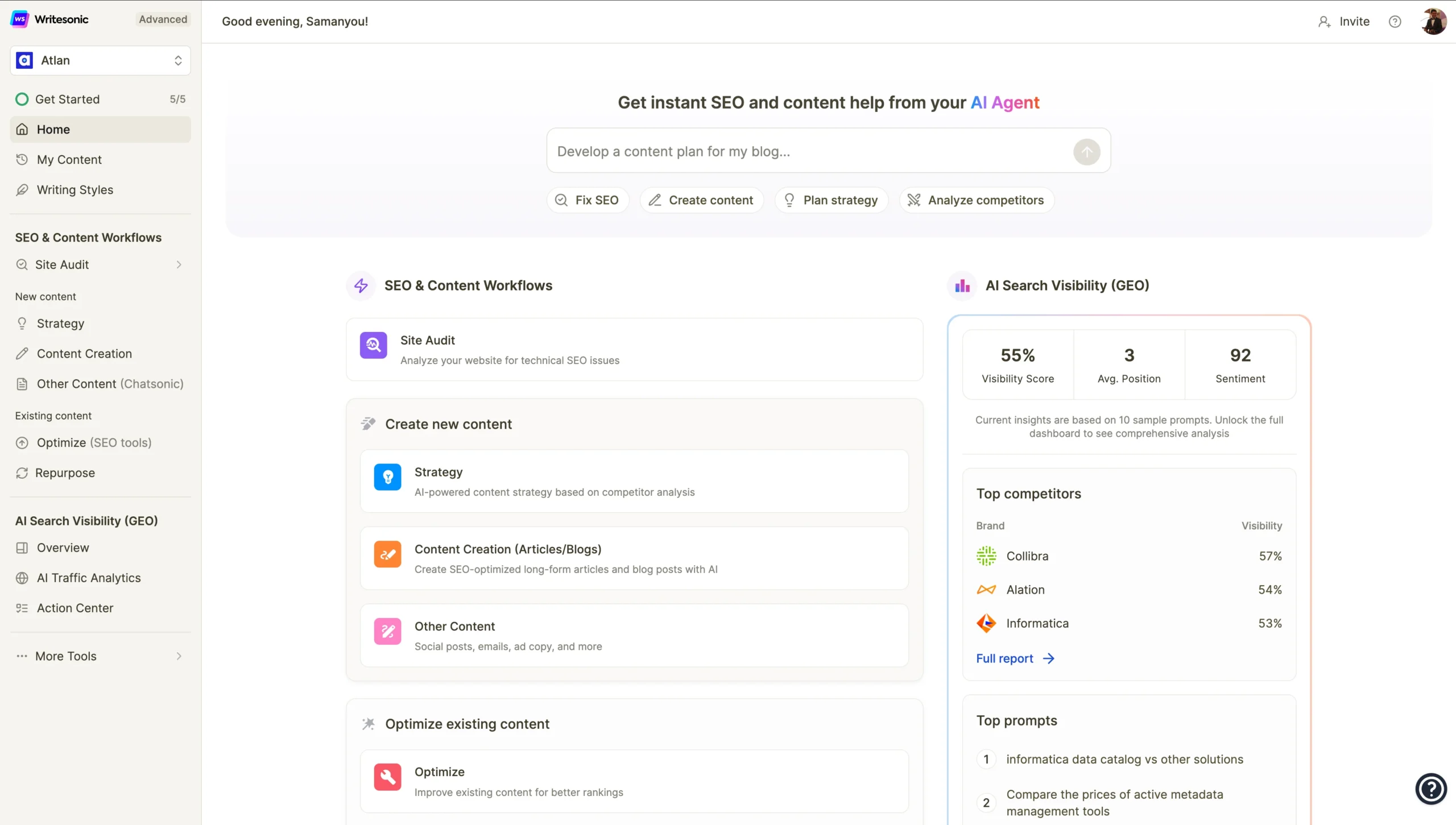
This is Writesonic’s most differentiated feature in 2026, and it is worth paying attention to even if you do not act on it immediately.
GEO tracks how often your brand appears in AI-generated search results — specifically in ChatGPT, Perplexity, and Google AI Overviews. As more of your target customers start their research through AI-powered answers rather than traditional Google searches, knowing whether your brand gets cited in those answers becomes a real competitive question.
No other major AI writing platform offers this kind of AI search visibility tracking at this depth. For startup founders building brand awareness in competitive SaaS categories, GEO gives you a metric that most competitors are not even tracking yet.
But here is the problem: Full GEO features require the Professional plan at $199/month or higher. The entry-level tiers give you a preview, not a working workflow. We will come back to this in the pricing section.
Writesonic includes a built-in site audit tool that scans for traditional SEO issues alongside GEO barriers — a combination that is useful for startup content teams who cannot afford both a dedicated SEO platform and a writing tool.
The keyword research module pulls data from Google Keyword Planner and integrates with Google Search Console. It is functional, though not as deep as dedicated tools like Ahrefs or Semrush. For early-stage startups who do not yet have a full SEO stack, this covers the basics adequately.
For startups already using Surfer SEO, the Surfer integration on paid plans allows you to keep your existing optimization workflow intact while adding Writesonic’s drafting speed on top.
Botsonic lets you build a custom AI chatbot trained on your website content, help docs, or uploaded PDFs. Deploy it for customer support, lead qualification, or internal knowledge queries — all without writing a line of code.
This is a legitimately useful feature for early-stage startups who cannot staff a customer support team around the clock. The value case is real: a trained Botsonic bot can handle repetitive support queries and qualify inbound leads at a fraction of the cost of a human agent.
Important note: Botsonic is sold as a separate subscription and is not included in the standard Writesonic writing plans. The “all-in-one platform” positioning can be misleading if you assume it is bundled.
Writesonic covers the most common startup content formats out of the box: Facebook and Google ad copy, email subject lines, product descriptions, LinkedIn posts, AIDA-framework sales pages, website hero copy, and more. For a founder who needs to move fast across multiple channels, the template library reduces time-to-first-draft considerably.
Writesonic’s pricing has been restructured multiple times, which is worth flagging directly. Historical plan names — Small Team, Freelancer, Business, Individual — appear across review sites and social discussions, making it hard to compare apples to apples. Always verify current pricing on writesonic.com before committing.
As of mid-2026, the approximate structure is:
| Plan | Monthly Price (annual billing) | Best For |
|---|---|---|
| Free | $0 | Testing the interface only |
| Lite | ~$16–$39/month | Solo founders, light blogging |
| Standard | ~$39–$79/month | Small content teams, regular publishing |
| Professional | ~$199/month | GEO tracking, advanced SEO, agencies |
| Advanced/Enterprise | $249–$499+/month | High-volume teams, custom needs |
The free plan is genuinely limited — it provides a one-time trial allowance rather than a permanent monthly free tier. Once the allowance is used, you are prompted to upgrade. This is different from how Copy.ai handles its free tier, which is ongoing (though restricted).
The credit system on lower tiers can surprise new users. Different features consume different credit amounts — a short social caption uses 1–2 credits, while a full SEO article from Article Writer 6.0 uses 5–8 credits. If you hit your credit ceiling mid-month, you either pay for more or wait for the next cycle.
The honest startup math: If you want the feature that actually differentiates Writesonic from its competitors — GEO tracking — you need the Professional plan at $199/month. That is a meaningful spend for a pre-revenue or early-revenue startup. The Lite and Standard plans are solid content drafting tools, but at that price point, so are several alternatives.
| Writesonic | Jasper | Copy.ai | |
|---|---|---|---|
| Starting price | ~$16/month | ~$39/month | Free (limited) |
| Long-form SEO content | ✅ Strong | ✅ Strong | ⚠️ Moderate |
| Permanent free plan | ❌ Trial only | ❌ No | ✅ Yes |
| GEO / AI search tracking | ✅ Best in class | ❌ No | ❌ No |
| Brand voice consistency | ⚠️ Good on paid | ✅ Strong | ⚠️ Moderate |
| Output quality (no editing) | ⚠️ Requires editing | ✅ More consistent | ⚠️ Varies |
| Built-in chatbot builder | ✅ Botsonic (separate) | ❌ No | ❌ No |
Writesonic wins on price and GEO. Jasper wins on brand voice consistency and output polish. Copy.ai wins on free-tier accessibility. Which matters most depends entirely on your startup’s current content goals and budget constraints.
For a broader look at how these tools compare across different use cases, see our AI Content Marketing Tools roundup on AIToolCamp.
Across G2, Capterra, and Trustpilot, the feedback patterns are consistent:
Positive themes:
Recurring complaints:
Good fit:
Not a good fit:
✅ Fast article generation — full SEO draft in under 60 seconds ✅ GEO tracking is genuinely differentiated and forward-looking for AI search ✅ Chatsonic gives multi-model access (GPT-4o, Claude 3.7, Gemini) in one interface ✅ 100+ templates covering most startup marketing content formats ✅ Surfer SEO integration available on paid plans ✅ Botsonic is a legitimate add-on for lean customer support automation ✅ 25+ language support for international content teams
❌ Output quality is inconsistent — long-form content regularly reads as “obviously AI” without substantial human editing ❌ GEO features (the real differentiator) locked behind $199/month Professional plan ❌ Pricing structure has changed repeatedly, making long-term cost forecasting unreliable ❌ No permanent free tier — the free plan is a one-time trial allowance ❌ Billing complaints on Trustpilot are a genuine concern for cash-conscious startups ❌ Botsonic and Chatsonic are not fully bundled into base plans despite the all-in-one positioning ❌ AI detection failure rate is high on long-form articles ❌ Dashboard can feel overwhelming for new users across its many feature areas
Rating: 3.9 / 5
Writesonic is not a bad tool — in fact, for the right use case, it is very good. If you run a content-heavy startup that publishes regularly to build organic traffic, need a fast first-draft engine, and have the budget to reach the Professional plan where GEO kicks in properly, Writesonic delivers meaningful value.
The GEO feature alone is worth serious attention. As AI-powered search engines continue displacing traditional Google results, knowing whether your brand appears in AI-generated answers is an emerging competitive advantage — and Writesonic is ahead of the market on this.
But the path to that value is not cheap or frictionless. The entry-level plans are solid content drafters, but they do not differentiate Writesonic from cheaper or free alternatives. The billing history and pricing volatility are real risks for startups who need predictable costs. And the output quality gap — the amount of editing needed to make AI-generated content actually read well — is something every founder should account for honestly in their time estimates.
Use Writesonic if: You are publishing regularly for SEO, have $79–$199/month to spend, and you understand that AI drafts are a starting point, not a final product.
Look elsewhere if: You need publish-ready content at minimal cost, reliable billing, or a permanent free tier to evaluate risk-free.
If Writesonic does not feel like the right fit, here are the closest alternatives reviewed on AIToolCamp:
What is Writesonic best used for? Writesonic is best suited for producing high-volume SEO blog content, landing pages, and ad copy quickly. It works well for startups that need consistent content output but have limited writing resources. It is less effective for nuanced technical content or thought leadership that requires deep expertise and a strong editorial voice.
How much does Writesonic cost in 2026? Paid plans start from approximately $16–$39/month on the Lite tier when billed annually. The Standard plan runs $39–$79/month, and the Professional plan — which unlocks full GEO features — is $199/month. Pricing has changed multiple times, so always verify the current rates at writesonic.com before committing to an annual plan.
Is Writesonic worth it for early-stage startups? Conditionally yes. If you publish 4+ SEO articles per month and have the budget for at least the Standard plan, it saves meaningful time on first drafts. If you are drawn to the GEO features, you will need the $199/month Professional plan to access them fully, which is a significant spend for most pre-Series A teams.
How does Writesonic compare to Jasper? Writesonic is cheaper and has a more differentiated GEO feature. Jasper produces more consistent brand voice output and requires less editing on average. For startups on a budget prioritizing volume, Writesonic; for startups prioritizing quality consistency, Jasper.
Does Writesonic have a free plan? There is a free plan, but it is a one-time trial allowance rather than a permanent monthly free tier. Once the credits are used, you need to upgrade. This differs from Copy.ai, which offers an ongoing free plan with restricted features.
Is Writesonic content detectable as AI? Based on user feedback across multiple review platforms, long-form Writesonic content frequently fails AI detection tools without significant human editing. If you submit content to clients or publications with AI disclosure policies, factor in editing time or use a humanizer tool as part of your workflow.
This review is based on publicly available user data from G2, Capterra, Trustpilot, and independent testing as of June 2026. Pricing details are approximate and subject to change — always verify current plans at writesonic.com. For more AI tool reviews, visit AIToolCamp.com.